

By HEVELYN’Z
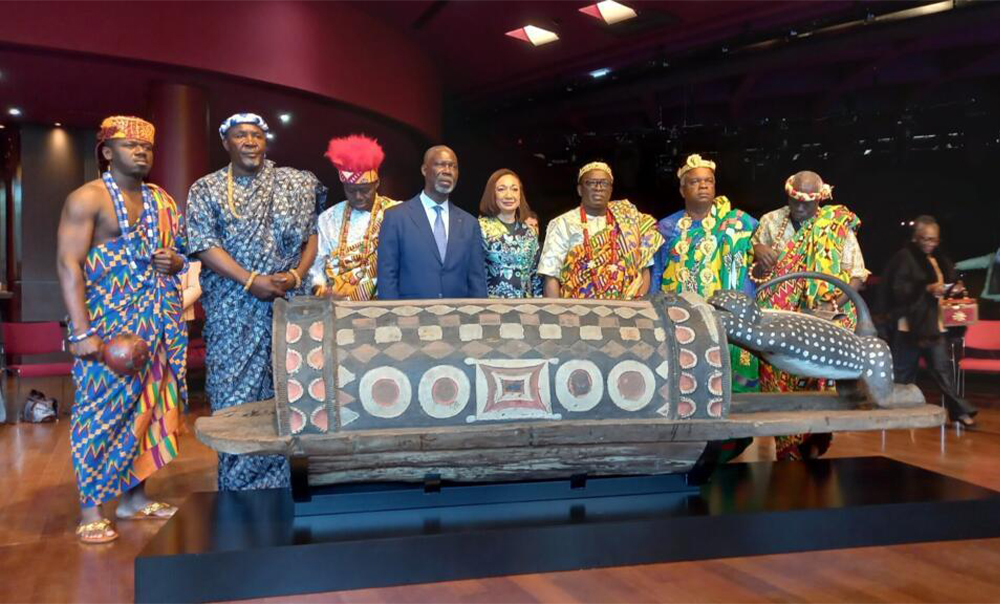
The Djidji Ayokwe is a cultural symbol of the Atchan people, also known as the Ébrié. Originally, this instrument was called “Aya Yokue.” In the Atchan language, “Aya” means tree or wood, while “Ayokwe” refers to the iroko tree, considered sacred. The term “Djidji,” meaning panther, was later added. The panther, a symbol of strength and power among Atchan ancestors, was associated with the instrument to represent the strength of the Bidjan people. Thus, the name Djidji Ayokwe was born.
The drum is believed to have been carved by an artisan named Biegui. According to oral tradition, King Nandjui Abrogoua later requested that this instrument become a shared symbol for all Bidjan villages.
These villages, numbering seven—Abidjan Adjamé, Abidjan Attécoubé, Abidjan Agban, Abidjan Santé, Abidjan Locodjro, Abidjan Anoumabo, and Abidjan Cocody—shared a common symbol of unity and power.
In the past, the Djidji Ayokwe played a central role in the social and spiritual life of the Atchan people. This giant drum, over three meters long and weighing nearly 430 kilograms, served as a means of communication between villages, and its sound could travel between 20 and 30 kilometers. But it was not just noise: each sound carried a coded message that only initiated members could interpret.
The message varied depending on whether the drum was struck on the upper or lower carved lip. It could signal danger, an attack, an important meeting, or an exceptional event in the village.
More than just a drum
Beyond its cultural role, the Djidji Ayokwe had a sacred dimension, involving blood rituals believed to preserve its spiritual power during use. According to tradition, the drum was entrusted to a single guardian responsible for protecting it, making it sound, and performing the rituals linked to its spiritual force.
The iroko tree used in its construction could not be cut without specific ceremonies intended to obtain permission from the ancestors.
For elders, the Djidji Ayokwe was not only a communication tool but also a military instrument during the colonial period, used to indicate areas occupied by colonial forces.
Today, after more than a century of absence since its removal by colonial powers in 1916, the return of the Djidji Ayokwe to Côte d’Ivoire represents far more than the restitution of an object. For the Atchan people and the Bidjan villages, it is the recovery of their history, dignity, and cultural heritage.